AN INVISIBLE MOMENT
Sergio Gaut vel Hartman
“Wait. Stay a moment longer”. The man looked incredulously at the prostitute. He had finished dressing and took a nervous puff of his cigarette as if the request had been something extravagant or out of place.
“I’ve already paid you, haven’t I? What am I going to stay for?”
“Just for a minute”. It was the first time that she had ever asked that of a customer and she didn’t know why she was doing it. It was an impulse, a stifled impulse, a desperate attempt to change something unchangeable. “Stay a minute longer, you don’t have to do anything”.
The man didn’t know why he agreed either, but he sat on the edge of the bed and spent the minute looking at his wristwatch. It was a cheap watch.
“Is that it?” he asked when the minute had elapsed.
“That’s it,” she said, “You can go if you want”.
The fifth customer wanted to know.
“What are you doing it for, girl?”, he spoke strangely, with a hard accent, respectful and suspicious at the same time. But he had not treated her gently. He was coarse and clumsy.
“I don’t know yet, sir. That makes five”.
“Five minutes, girl?”
“Yes”. She did not think it proper to add anything. The man stood silent. He did not look at his watch. He did not wear it.
“Is that it?”, he asked when he thought the minute had passed. That was the only thing that made them all equal. They all asked, “Is it already?”. It didn’t matter if they had a watch or not.
“That´s it. Thank you,” she said.
The twenty-third – no argument there, because she meticulously counted every minute she gained and wrote it down in a red-covered notebook – was an expert arrow-shooter, an archer who participated in competitions. He was more surprised than the others, but he was generous.
“One minute? It could be five or ten. It’s very nice, it doesn’t bother me, not at all”.
“Ten?”, her eyes sparkled. She didn’t expect anyone to give her ten whole minutes voluntarily.
“Ten, twenty, as many as you like. No one waits for me. I do nothing in life but shoot arrows and sometimes be with a pretty girl for…”.
“Ten is all right,” she said, stunned by the archer’s generosity.
“I suppose you’ll want to know. The archer, the bow, the arrow, and the target are one…”.
She wasn’t interested in the man and his bow, his arrow, and the target waiting patiently to be attacked. But the archer wanted to talk about it and continued with his precise, thorough, and unnecessary explanation.
Thanks to the archer, this very fine and elegant old man, she was able to complete the first hour. The old man was not up to the task, but he still gave her half an hour, in silence. He only asked her to remain naked and still, to which she agreed without complaint. He spent the half hour looking at a mole between her breasts. Not at her nipples or vulva: the old man was looking at the mole. It was the first time she said “That’s it”, and it wasn’t a question.
The time had come to find out what the full hour she had obtained meant. It was her innocent hour. She didn’t have to share it, she didn’t even have to show it to anyone, although she was almost certain that none of the people around her would be able to perceive the subtle texture of those sixty minutes, the fragile weave of the seconds, interwoven like crystals of snow. She also wondered if it was wise to keep accumulating time or if, on the contrary, she should spend it before it burst like a soap bubble.
The return was painful, as always. The same shouting and blaming awaited her. The money, the only thing that mattered in that house, once again passed from her hands to theirs. But that was irrelevant and she decided not to spend the time she had accumulated on this withered dimension of her life. She looked at dad’s stumps and sniffed at mum’s sour drunkenness as if they were both supporting actors in a bad TV show. She slammed the door. Mum staggered, trying to stop her. Dad not even that.
By a strange coincidence, she completed a whole day with the thousandth customer. The last few minutes were given to her by a Liberian sailor with whom she was unable to exchange a word. But the man understood what she needed as if a natural contiguity with fundamental things allowed her to ignore the signs. It was eleven minutes exactly and she had a complete day, her thirty-second of January. A fugitive lapse captured by an incomprehensible ruse, a trap. It belonged to her, it was hers, her own, and all she was worried about was when she would have the courage to use it.
“Thank you,” she said.
He shook his head, his eyes sparkled and his tongue moistened his lips.
“Thank you,” he repeated, not knowing what he was saying. It would have been a mysterious wonder to meet her without money playing a part in the game. “Thank you,” she repeated. It was a beautiful word that rolled and sounded like a fish caught on a hook.
She smiled and opened the door for him. But he did not leave. He took notes of different countries and values out of his pocket and with them, he wrote sweet words that meant more or less the same thing in any language.
“I can’t,” she said, shaking her head. “I’ve completed my day. I won’t do it again”.
He balled up the money and put it in his pocket again. He had understood. She took his hand and forced him to touch her damp eyelids.
“Thomas,” said the sailor, signalising at his chest.
“Samantha,” she said, twisting her mouth and shaking her head. “No. It’s not true, my name is Rosa”.
“Rosa,” he repeated, slurring the syllables into a harsh, windy sound, dry as the puff of breath on a hollow reed.
“You must go. Leave,” said Rosa, pointing to the door. Thomas nodded sadly. He took two shuffling steps and grasped the handle; he pushed down and turned his head. At that moment he saw the whole day spinning in waves and spirals of colour around Rosa. She tried to hide the day in the folds of her blouse but discovered that she was naked. Too late for everything, she moved her arms like blades, like a butterfly trapped in jam, and closed her eyes, inviting the sailor to do the same.
Thomas blinked. He could clearly see the extra day she’d obtained. It was a colourful fusion of lace and embroidery. On the sides, near the points where each minute rushed into the next, were visible golden rivets, with protrusions like hooks and barely perceptible discs spinning at full speed. The whole thing looked like an evil or at least devious beast, ready to do its inexorable bidding.
“Rosa?” he tried to move forward and was stopped by the girl’s raised arm.
“Don’t touch it!”
“No?” Thomas, who in addition to his affinity for scents possessed the intuition of travellers, knew that this place was off-limits to him. A sailor knows the forbidden ports or which tavern he will leave with a cut in his face. No is no, resounding, definite. First, he stopped and then made an undefined gesture of confusion, or defense, but Rosa didn’t know how to interpret it. She thought that the raised hand, like so many other times, would be unloaded on her face and she covered herself with her arms crossed.
“No! No is no”. He understood and spun like a spinning top. He stretched his body along the concentric circles of a misty premonition and curled into a ball. He could not express in words, words of another language, which Rosa would not have understood, that he too had an unbroken day, built from remnants of tides, waves, storms. What is it, after all, that we pursue throughout a lifetime? But neither could I tell them that if they were put together, they would have two perfect days, two gems that could merge until they lost their identity and became so much more than twice themselves.
Rosa sensed something of that, though she would not risk it. She must not expose her unbroken day to the chance of a strange breath. The intricate amalgam of spirals turned in on itself to expose the entrances to the breeze blowing in from the distant sea, and it named each of the points that pulsed in the room. A golden glow shone like the wings of a hummingbird flapping at full speed.
Thomas, who had nothing to lose, summoned his friends from the shadows. He dressed himself in the glimmer of a broken youth in a town called Soboe, reviving the symmetrical misfortunes of a drunken and battering father, a mother raped by soldiers during one of many wars. To be born, in Liberia, is the same as being lynched by a bloodthirsty mob in Glew or somewhere in the Caucasus. Then, one who had nothing to lose, created a supple, subterranean, pleasant glow, the kind of material that invisible birds hatch in their nests, sheltered it in the hollow of his hand, and thrusted it into Rosa’s chest. He said something in his language, a word of apology, capable of expressing all the love in the universe.
And while the woman was bleeding to death, he found the strength to cut his jugular vein with the edge of a wave cultivated in an invisible ocean. Time, convinced that this was the best end allowed by the personal history of these two, joined Rosa’s and Thomas’s won days, and then multiplied them by two, by four, by eight, by infinity. Later, much later, it left the room, locked it for good with a key, and threw it into the jaws of a dragon that happened to be passing by.
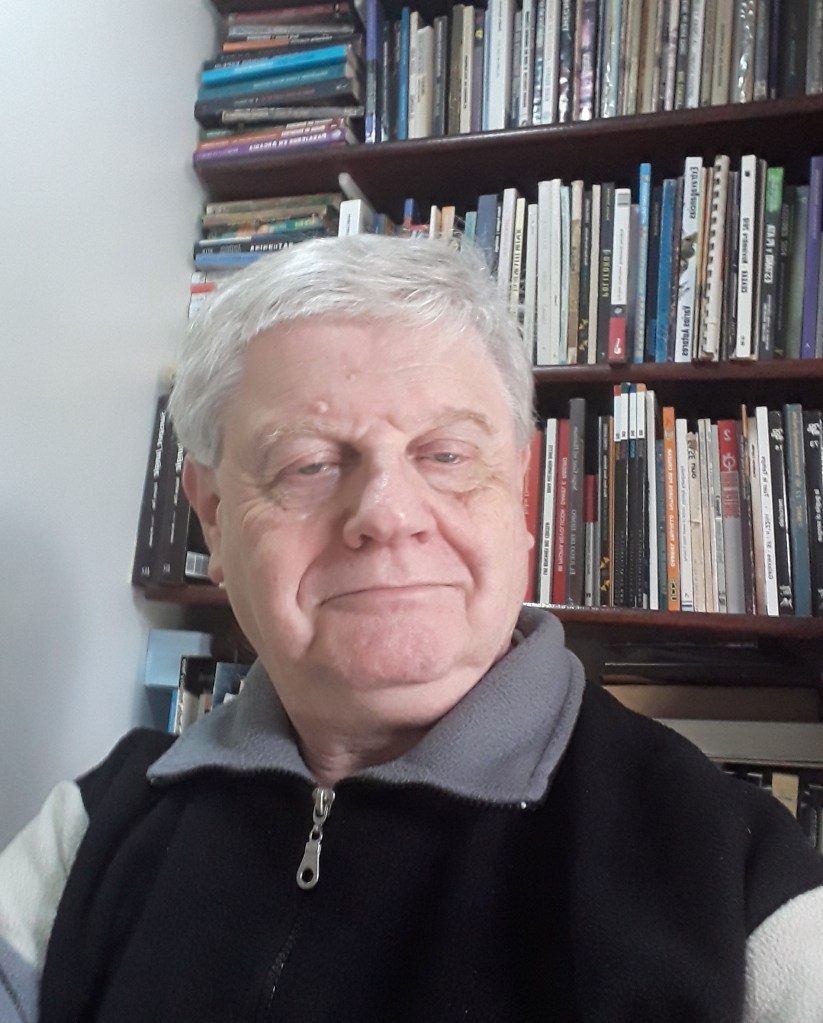
Sergio Daniel Gautvel Hartman is an Argentine writer, editor and anthologist. He had numerous books published, such as El universo de la ciencia ficción, Avatares de un escarabajo pelotero, El juego del tiempo. He was a finalist for the II Minotauro premio, the Ignotus premio, among others.
 Literaven.com