AESTHETIC VIOLENCE IN ART
Beatriz Jimena Hernández Ochoa
“The beautiful is the beginning of the terrible that we can still endure“.
Rainer Maria Rilke
I found myself contemplating myself from the outside, before a work looking at me through my insides. It whispered carefully from its colours to attract my attention to a memory I thought already forgotten, hidden from everyone, and buried in my thoughts. However, it revealed itself by debating my existence by slowly fading its form to become a mirror of my face, the reason for my hands, and the reason for this walk. It stayed like this, a heartbeat present with every second as I observed and grew with the passing of time, in which, I remained still waiting for a call. Within me, calm and fury emerged as the same sensation, as warm as solace and as vivid as agony. There, as the work portrayed me, my world collapsed, returning to me a part of my Self waiting in the half-light.
Art is a human manifestation that has accompanied us since the beginning of humanity (Gombrich 1997). It has been a vehicle of expression from the sensitive and perceptible through the senses, which lead us to live at times the unthinkable and throw us into worlds that escape our everyday life (Bueno 1983). The aesthetic quality in which art has been shaped by artists has depended on several factors, from the artist’s own vision, his way of seeing the world, as well as the symbolic interpretation of reality1. In this inner daring that unveils meanings, a truth emanates from its longing to be found. This result, therefore, will have its edges of existential possibility for artistic appreciation and contemplation. However, there we will find the existence of certain categories, helping us to understand art from different perspectives (Bueno 1983).
For example, when talking about beauty in painting, we usually allude to aesthetic contents that denote subtle forms, warm colours, soft and subdued brushstrokes. With this, we may think of a still life painting, a landscape, or Degas with his iconic dancers. But, if we think of other categories, such as the sinister, we will find an aspect where the contents are raw, scandalous, and directly impact the viewer. They do not limit themselves to show, from the crudeness, the translucent tragedy in a visual impact. Its vitality is therefore provocative and inciting, as if the work knows the effect offered while patiently waiting to enjoy the reaction of those eyes that are in the view.
In this sense, let’s talk about the beautiful and the sinister in terms of the violence, exposed in the latter aesthetic category. First, I would like to understand violence here as damage in the explosion of a situation, those symbolic expressions that make use of tragedy, drama, and our uncomfortable emotions. I try to understand aesthetics as the science of sensitive knowledge (Bayer 1998), since it studies not only the beauty contained in those artistic manifestations but also classifies and directs the analysis to understand the work of art. Therefore, when enunciating the sinister from the aesthetic vision, we must go back to the aesthetic categories and what is permissible within artistic expression, the freedom of the artist, and the styles that each artistic epoch offers. In this way, accompanied by our sensitive expression, we will be able to perceive the intentionality of the work and recreate it in our appreciation of the work itself. With it, the aesthetic values will surround us beyond the thought within the game of art, being thus participants of an atmosphere in a world within the work and the emotions that it offers us for our organism. Although, what we are presented with in works such as Francisco de Goya’s “Saturn devouring his son”, Degas’ “Interior” or Caravaggio’s “Judith and Holofernes”, will be an aesthetic appreciation of the technique, as well as the evaluation of the contents from an artistic and not exactly moral sense.
The aesthetic value is in itself (Pochat 2008), since it is not logical but aesthetic (Kant 2014), in such a way that the subject sees how he or she is affected by the representation, which as spectators encapsulate us in this universe of ontological-aesthetic possibilities to denote a shared vision. This is an aesthetic experience, between pleasure and enjoyment that entails vertigo (Trías 1982). Therefore, the sinister constitutes a condition and limit of the beautiful, that is to say, it is a condition and limit given organically within the representation and by creating in us a human reaction. The sinister produces that experience, even if it is repulsive, due to the game of art where one does not decide what one is going to face, this aesthetic mobility will have us in the light of the unexpected. And it will be in our contemplation where we will see its ontic gift, whether from the artist’s vision of the time or ourselves. In the face of this, Kant mentions to us the possibility of art being able to deal with any subject and promote any feeling regardless of morality or horror (Kant 2014). That is why we do not judge what art shows in itself as violence, on the contrary, it shows us in an aesthetic way the violence produced by the artist’s hand: it forces us to feel and understand the artistic.
As has been shown, in the face of the violence exhibited in artistic creations, we can see its aesthetic beauty, which certainly makes us uncomfortable, but puts us to the test when we react from a sensitive point of view. Therefore, the work does not lose its aesthetic value because of the violence expressed in it, but rather, it is another means of the manifestation to recreate it. The artist takes from his resources the sensitive image of an idea and shapes it with intentionality. He takes out of himself a fragment of himself, the tragedy that imprisons him and liberates in the work: the drama of living. The sinister is shown as the disturbing, the strange, and unveiled, that which at the same time hides a desire from our human nature. It is even possible to see it as an unveiling of our anthropological condition. Perhaps from within we can understand why this unspoken violence is unleashed and why we do not necessarily wish to commit it. Nevertheless, it shows something of our Self that comprises our human powers, and perhaps in this we can identify ourselves. This aesthetic category and the contained violence in it are in a raw way familiar to us.
However, for the aesthetic question, the important thing will be to carry out an analysis of the forms and sensations from the semiotics of art (Bayer 1998), and thus be able to judge understanding consciousness as a state of feeling (Kant 2014). From this perspective, violence expressed in art is aesthetic. On the one hand, by awakening emotions from the possible, where the sensory senses favour this type of experience. On the other hand, containing a semiotic symbology of the work represented gnoseological in its anthropological-social nature. Therefore, the discomfort founded in us does not devalue the work, so this sensation will be one of its “expected” effects in the sinister category of aesthetic violence. The work, as Kant mentions in the Critique of Judgement (Kritik der Urteilskraft), generates any feeling and that makes it aesthetic. Precisely its provocative essence gives it a revealing essence. Given this, let us remember that the experience of disgust is excluded from aesthetic enjoyment, this being the limit of the beautiful in artistic manifestations, which opposes us with non-aesthetic violence, while violence in the sinister expresses an extra-artistic and valid content in its representation.
As the sinister is the limit of the beautiful, it implies that this must remain in a certain way expressed with subtlety. For this reason, when it is revealed in its totality it can dismantle the aesthetic effect and therefore its contemplative notion will not be considered within the elements of the beautiful (Trías 1982). The artist, for his part, plays with these elements from the moment of his creation. He knows as a spectator of his own work the horizon of understanding and in a certain way he imaginatively anticipates the contemplative reaction. With the above, we can appreciate the marvellous thing about art, how in its forms and contents it expresses intentionality, but at the same time hides others that are kept in suspension. An illusory veil of artistic and sensitive nuances coexists here. The same one that procures in the work of art the possibility of being understood and endured.
As a concrete exemplification of the aesthetic violence of art, I would like to propose three works, the first of which is “Saturno devorado a un hijo” (Saturn devouring a son) (Goya 1823) by Francisco de Goya. It is a mural from the collection of the artist’s so-called 14 black paintings, so called because they contain dark elements, from the technique to the symbolism.
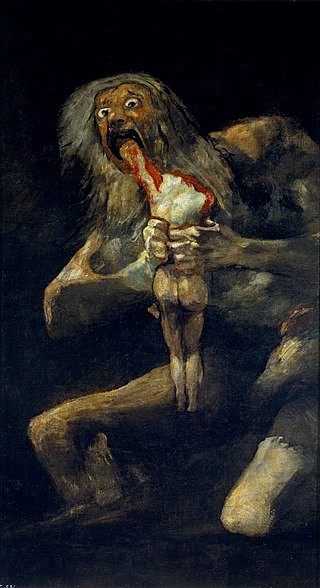
The work in question tells the mythological story of Saturn, God of time, devouring one of his children in terror that they were more powerful than he was. Although the vision is crude and cruel at first glance, we can later appreciate a melancholy in Saturn’s gaze, his wild eyes and his corporeality denote sadness. Despite being a heartbreaking act, he is also suffering. For that reason, it reminds me at times of human actions committed with cruelty when we feel cornered, when fear drives us to behave like beasts, and perhaps while he was devouring his son, he was regretting it. Although it was too late, there was no turning back. Ironic that the God of time cannot restart his actions, even if in the process he had identified his mistake. This is sustained by the pain expressed on his face when there is no satisfaction in his actions.
However, the reason for using it in our analysis lies not only in its aesthetic beauty from the artist’s technical point of view. In this sense, the brushstroke can even be considered violent, because of how the artist expresses the connection from his sensibility and intentionality. On the other hand, from the vision of the sinister, we could think of the existence of a filter, which in its own plane shows a representative reality, of human contents with the existential possibility of happening, leaving a glimpse of a light of cruelty. At the same time, it shows our human nature, that is to say, the set of actions we are capable of committing as humanity. It is, therefore, the arc of art as an image of ourselves confronting our dark sensations.
The next work I would like to use as an exemplification is “Judith and Holofernes” (Caravaggio 1599) by Caravaggio, which shows amidst an intense drama a crude scene of a murder.
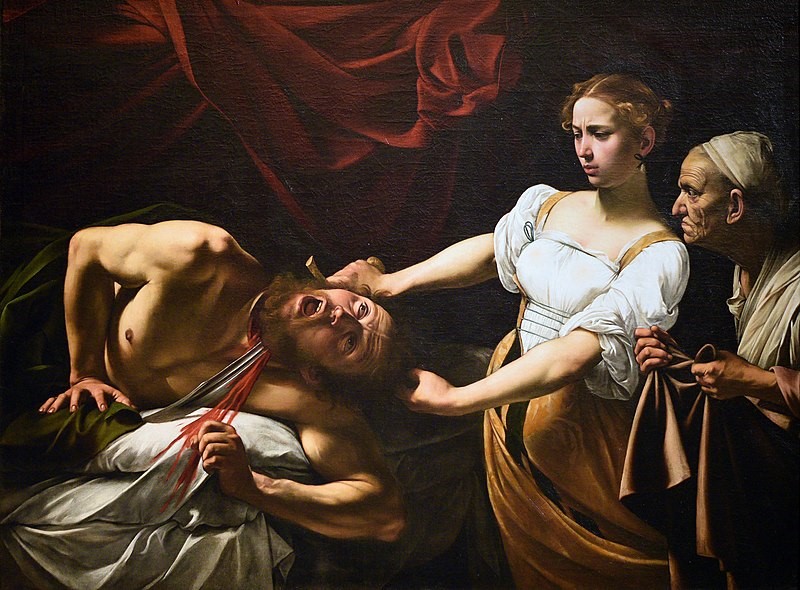
Judith, with the help of a maid, slits the throat of the Assyrian general Holofernes. At first glance, there seems to be a deep determination in her act, and even her body language shows firmness. At a second glance, we can see how the maid hesitates and shows fear in her gaze, Judith herself reveals an expression of repulsion and discomfort. Even though they both knew that their actions were for the greater good, they still condemned their actions. Even though they did it for the benefit of the majority. Perhaps they wanted Holofernes’ injustices to end, even though they could find no other way to put an end to the tyrant. This painting contrasts with the work of the painter Artemisia Gentileschi, who years after Caravaggio’s work created her version, which, although depicting the same act, shows it from a different perspective, with a view in which Judith and the maiden almost seem to enjoy the act, as if committing revenge. Their faces show resentment and hatred towards Holofernes. Aesthetically, both works make use of light and care for the delicacy of the forms, even though the colour palette is similar. However, in the case of Caravaggio’s work, the sinister seems to be shown with greater intensity. As the action does not seem so intentional in the expressiveness of the faces, it reveals something that is not fully revealed, leading to a mystery of interpretation.
The third work I would like to mention is “The Rape” – “Interior” (Degas 1869) by Degas, which shows us a disturbing scene with an aggressive nuance, of violence that has not yet happened and will soon happen.
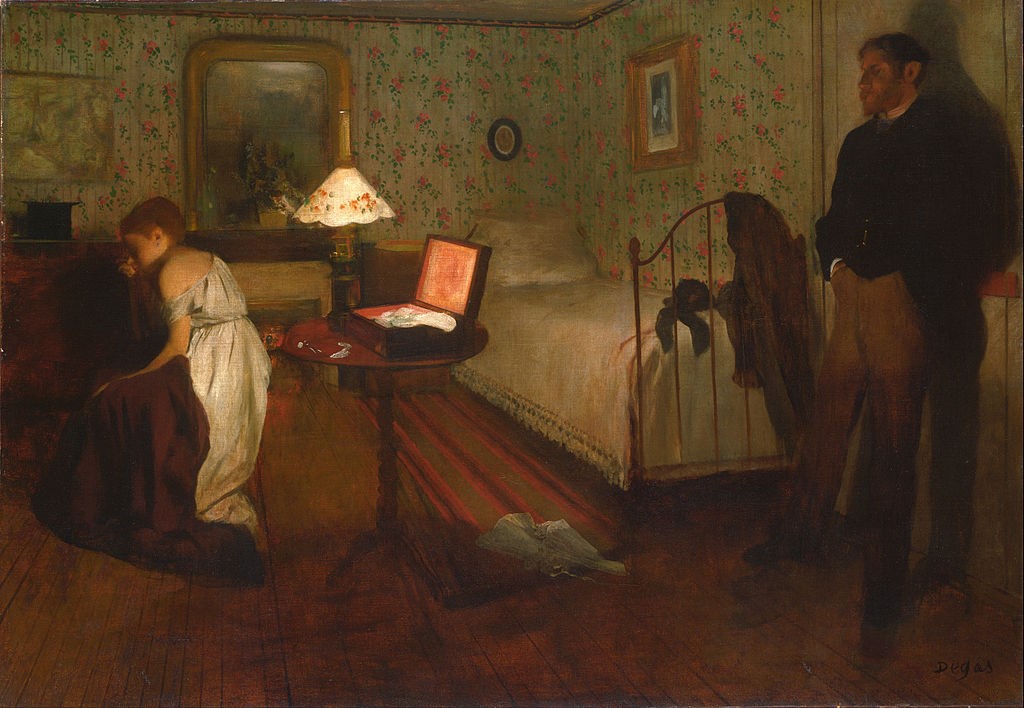
From the viewer’s point of view, suspense persists in the work, one can interpret the atmosphere and perceive an ambience of suffering. The fear for the young woman’s body makes us empathise with her situation, at the same time, impotence arises in us once we sense the proximity of violence, while we can do nothing to save her. In the aesthetic play of the composition of the work, we can see how the light has the effect of a reflector, illuminating the scene to direct our attention to the young woman who shows vulnerability. In the shadows, the figure of the man observing her, enjoying the moment before the chaos. There is no doubt in the subject’s expression, nor his body language. He shows power over her, possessing her with his very presence. The most dramatic terror of the painting lies in the discovery of a rape that has occurred even before it explicitly happens.
This type of violence expressed in the three works leads us to understand the darkest part of our Being, hence none of these scenes is a fiction in our human history. We may like the works for their aesthetic manifestation in technique, for their symbolic content, or the morbidity emanating from them. I therefore think that their classification fits perfectly within the sinister, as they still offer a limit to the beautiful. They do not generate that destructive nausea of the aesthetic effect, but they do offer that magnetic vertigo. Let us not be mistaken in thinking that aesthetic taste in the face of these artistic manifestations makes us applaud acts of rape, homicide, or cannibalism. This is not the desired argument. The premise here is based on the idea that even when violent content is shown in art, an aesthetic sense and enjoyment remain in the work. These produce in us a chaotic sensation of rapture before our ideas, striking the affective disposition to enter our intimacy.
The violence mentioned has the intention of communicating something, it is not shown without a purpose. Since, if it is communicated without an aim, it would go beyond the limits of the aesthetic and would be exposed as a false composition. That is to say, even to show violence in art it is necessary to have an aesthetic sense and to have an artistic foundation (Heidegger 1958). The limits of the beautiful and the sinister are clear in the aesthetic validity of the interpretative arc. Therefore, it is necessary to control from the game of art the imminent danger of real violence and to make use of a filter that allows artistic appreciation instead of reducing the contents to something out of control (Trías 1982). The artist, therefore, must offer his proposal in this exposed and controlled violence with a filter. It is not a “real” violence, and the painter is not precisely self-censoring. Rather because it is a painting, it is not real. However, in this representation, it becomes a presentation of violence and not violence in itself, which is why violence in art does not desensitise us. On the other hand, the red notes in the newspaper do. So, it is not the crudeness, it is the intentionality of what is shown, the form, the purpose of it, and what it makes us feel. Violence in art confronts our senses and opens the way for interpretation, while violence in the media offers us nothing to interpret. It has moved beyond the limit.
The sinister, although part of the beautiful, does not remain restricted to this category. It advances and shows itself in its light. Thanks to an understanding of art, we can identify a sinister work in aesthetic enjoyment and value it artistically (Kant 2014). I would even go so far as to assert that the sinister achieves a break with artistic everydayness, so to speak. As spectators, we get used to observing works of art that show us pleasant and subtle content. When we step out of this scheme and find ourselves in a different atmosphere, we experience a new scenario into which we throw ourselves in search of the limits of the beauty (Trías 1982). When it is revealed, the feeling of the sinister is born in us. It completes us and throws us into the work in an ontological plunge. From our existential gaze, the work reveals itself to us to invite us to a new manifestation of our emotions, and thus, as long as we can bear it, we will appreciate it as ours, being already part of us as a veil of our humanity.
To contextualise this last point, I would like to make use of the concept of Unheimlich, used by Freud, who defines it as “…a feeling of dread that clings to things known and familiar from long ago” (Trías 1982). This allows us to interpret, on the one hand, the existence of themes and/or contents used in art that may be familiar to us from our human condition. Naturally, we cohabit a world and realities that we are capable of understanding from our horizons of comprehension. On the other hand, it offers us a sense of the occult, as Schelling expresses when he mentions that “the sinister is that which, although it should remain hidden, has revealed itself“. By manifesting itself, it reminds us of something familiar but hidden. Therefore, the sinister shows itself to be strange, possibly by ignoring our natural state. Any of us could commit any of the actions shown in the previously mentioned pictorial works. By observing them we know it, it reminds us of who we are and although it puts us to the test in what is said, it gives us a relief not to belong to that expressed reality.
The sinister in art, in a way, speaks for all of humanity. It allows the artist to channel those ideas that have once passed through our minds as fears or repressed desires. It is possible that the sinister, as the limit of the beautiful, allows us to take a glimpse of our sensitive happening, reminding us of the possibility of experiencing other kinds of emotions denied in ourselves. Certainly, in beautiful art we find ourselves in a comfortable and familiar position, which does not allow us to go beyond the game of interpretation, as if what is expressed lets us see its contents with simplicity and it is difficult to interpret something different among the spectators. Namely, in the sinister, the game of understanding makes us uncomfortable, even if what we see is common to us and has remained hidden because it does not contain a habituality. Faced with this, we do not know how to react, or how to feel about it. I even dare to assert the possibility of judging ourselves if we enjoy the work knowing that its content is violent.
The sinister in art, in a way, speaks for all of humanity. It allows the artist to channel those ideas that have once passed through our minds as fears or repressed desires. It is possible that the sinister, as the limit of the beautiful, allows us to take a glimpse of our sensitive happening, reminding us of the possibility of experiencing other kinds of emotions denied in ourselves. Certainly, in beautiful art we find ourselves in a comfortable and familiar position, which does not allow us to go beyond the game of interpretation, as if what is expressed lets us see its contents with simplicity and it is difficult to interpret something different among the spectators. Namely, in the sinister, the game of understanding makes us uncomfortable, even if what we see is common to us and has remained hidden because it does not contain a habituality. Faced with this, we do not know how to react, how to feel about it. I even dare to assert the possibility of judging ourselves if we enjoy the work knowing that its contents are violent.
Therefore, aesthetic violence in art is a manifestation of the sinister, which from the tragic sense generates an uncomfortable orgasm, taking us back to ourselves (Gadamer 1991, p.96). The way in which art develops allows contemplation of transcendental life in historical temporality and in the cultural evolution of a society that is united under a sensitive manifestation. It is there, where the categorical vision of art breaks the paradigm of the canons creating new schemes to conceptualise ideas, break down emotions, and invite the spectator to be a participant in the game of art. Violence accompanies our human spirit from the possible, in a struggle between our contemplative catharsis and aesthetic pleasure.
1 We return in a different order to the table of definitions presented by W. Tatarkiewicz, Historia de seis ideas. Arte, belleza, forma, creatividad, mímesis, experiencia estética, Madrid, Tecnos, 1987. Chapter I, pp. 56-61.
Bibliography
Bayer, Raymond. Historia de la estética. México: FCE, 1998.
Bueno, Miguel. Principios de estética. Ciudad de México: Patria, 1983.
Caravaggio. «Judith y Holofernes.» Judith y Holofernes. Palacio Barberini : Óleo sobre lienzo, Barroco de 1599.
Degas, Edgar. «La violación.» La violación. EEUU: Museo de arte de Filadelfia , Óleo y lienzo de Impresionismo de 1869.
Gadamer, Hans-Georg. La actualidad de lo bello. Barcelona: Paidós, 1991, p.96.
Gombrich, Ernest. La historia del arte. New York: Phaidon, 1997.
Goya, Francisco de. «Saturno devorando a un hijo.» Saturno devorando a un hijo. Museo Nacional del Prado: Óleo sobre revoco trasladado a lienzo , Romanticismo de 1823.
Heidegger, Martin. Arte y poesía. México: FCE, 1958.
Kant, Immanuel. Crítica del juicio. Madrid: Minimal, 2014.
Pochat, Götz. Historia de la estética y la teoría del Arte. Madrid : Akal, 2008.
Trías, Eugenio. Lo bello y lo siniestro. México: Lectulandia , 1982.

She has a BA in Dramatic Arts and BA in Philosophy from UMSNH in Morelia, Michoacán, Mexico. She also holds a Master’s degree in Critical Thinking and Hermeneutics from UAZ in Zacatecas, Mexico.
 Literaven.com