The Fight
Rodrigo Urquiola Flores
It was a rush hour at ten o’clock on Friday night. Miraflores was packed, so we decided to cross Puente de las Américas. We were on 6 de Agosto, near Abaroa Square. Several minibuses crammed with people were ignoring us. As we were walking up the avenue, we held out our hands to any minibus heading to the South Zone to try our luck. One, heading to Ovejuyo stopped in front of us. What luck! I opened the door. There was only room for one standing passenger. Since my twelve-year-old son doesn’t take up much space, we could fit in that narrow aisle, I thought. One of the passengers was getting ready to get off. Just then, a lanky, pale guy arrived and started talking to someone inside. He grabbed the door with his hand and, taking advantage of the fact that I was more concerned with making sure no one hurt my son, he beat me to the entrance. While I was thinking about how to get him out of the way, because we had arrived first and it was our turn to get on, the passenger who was getting off, another skinny, pale man who turned out to be an acquaintance of the lanky man, pushed me. »Give me some space,« he said. He looked me straight in the eye. I did the same. Without blinking. I took half a step closer. He started waving his arms as if he were ready to throw the first punch. I took another half step closer. We were two animals sizing each other up, sniffing each other out without lowering our eyes. Just another dispute over territory. I reached into my pocket for the stone I always carry to scare off the most aggressive stray dogs in my neighbourhood or any potential thieves and…
»Here, you bastard,« I shouted. »What the hell do you think you’re doing?« The stone hit him right on the forehead. »Here«, I repeated, »Give me some space. Do you think you’re talking to one of your servants, you asshole? Times have changed, didn’t you know, you piece of shit?.« He takes off his green scarf with the emblem of a condor on a football to wipe the blood dripping from his wound. »I know what you’re thinking, but you don’t have the courage to say it anymore, do you? ‘These fucking Indians, these uneducated people.’ Say it, bastard. I have to put up with your disgusting class pact even on public transport. Don’t be afraid of the laws against racism, I’m not going to report you. What for? Without masks we can see each other better, we can try to figure out who’s who. Search your pockets. I don’t have my stone anymore. I’m sure you’ve got a little knife in there somewhere, you dog. I think I’ve seen you in Quinto Centenario looking for someone to sell you drugs. You walk around acting like an idiot, don’t you see? But you’re a useless person who doesn’t know how to work. You’ve already said it, you’ve already insulted me, so that’s better. Why should we hide who we are? Here. Let this punch in the stomach teach you to respect others. You wouldn’t talk to me in that spoilt brat tone if you didn’t think you were superior or if we had the same skin colour, would you? Is that what your parents teach you?« He gets up off the ground. He takes advantage of my distraction and lands a good punch on my nose. Who said spoilt children can’t fight? My son is crying. He wants to hit him too. I’ve gone too far. I regret it. It’s too late to back down now. As I dodge his clumsy kicks, I snort to stop the blood flowing from my nostrils. I spit at him and dirty him. He spits back at me and dirties me. Are we equal now? It’s his turn to insult me. »Resentful Indian, black man. Is that all you can think of to say to me? Didn’t they teach you any other words at your private bilingual school? Jackass. Let me find another stone, because you, or your parents, or your grandparents, or your great-grandparents, were the ones who threw the first cowardly punch. Thieves, all of you. Look what they’ve done to this country. And you don’t even know how to steal. Or you’ll steal from your own parents to buy your vices. Son of a bitch. I’d call you a shitty jailón[1], but it is clear you don’t even live in Calacoto anymore.« We get closer. We were about to strike one last blow, perhaps even the final one, now that we have run out of insults and the rage seems to have deflated. Both fists were static in the air, when, finally, the crowd around us separated us. »Police!«, someone shouts, »Police!«
…and I couldn’t find it. My green jacket with the emblem of a condor on a football on the side of the heart reminded me that I had thrown the stone before entering the stadium. Better that way. The Bolivian national team was playing a pre-Christmas friendly match and the etrance was a toy to give to poor children. The Hernando Siles stadium was completely full. That’s why there were so few minibuses. The lanky man entered at the back, taking the seat the other man had left empty. He got off at San Miguel. I positioned myself so that I was blocking the door to see if he would push me too. My knuckles stung from the blows I hadn’t been able to throw. »Can I get through, please?« he said. I moved aside without any problem. But I still found it hard to forget how on the 6 de Agosto, when my son and I were already settled in that narrow minibus aisle and the vehicle was moving slowly through the traffic jam, there were hostile glances. Even through the window, like dogs about to pounce on each other, they did not lower or blink. They did not want to let go. It was a trance. A real fight between citizens of two nations. living too close together, that have never stopped fighting. It is incredible that so many things can be said in such profound silence.
[1] Someone from a high social class or someone who acts like they are from a high social class.
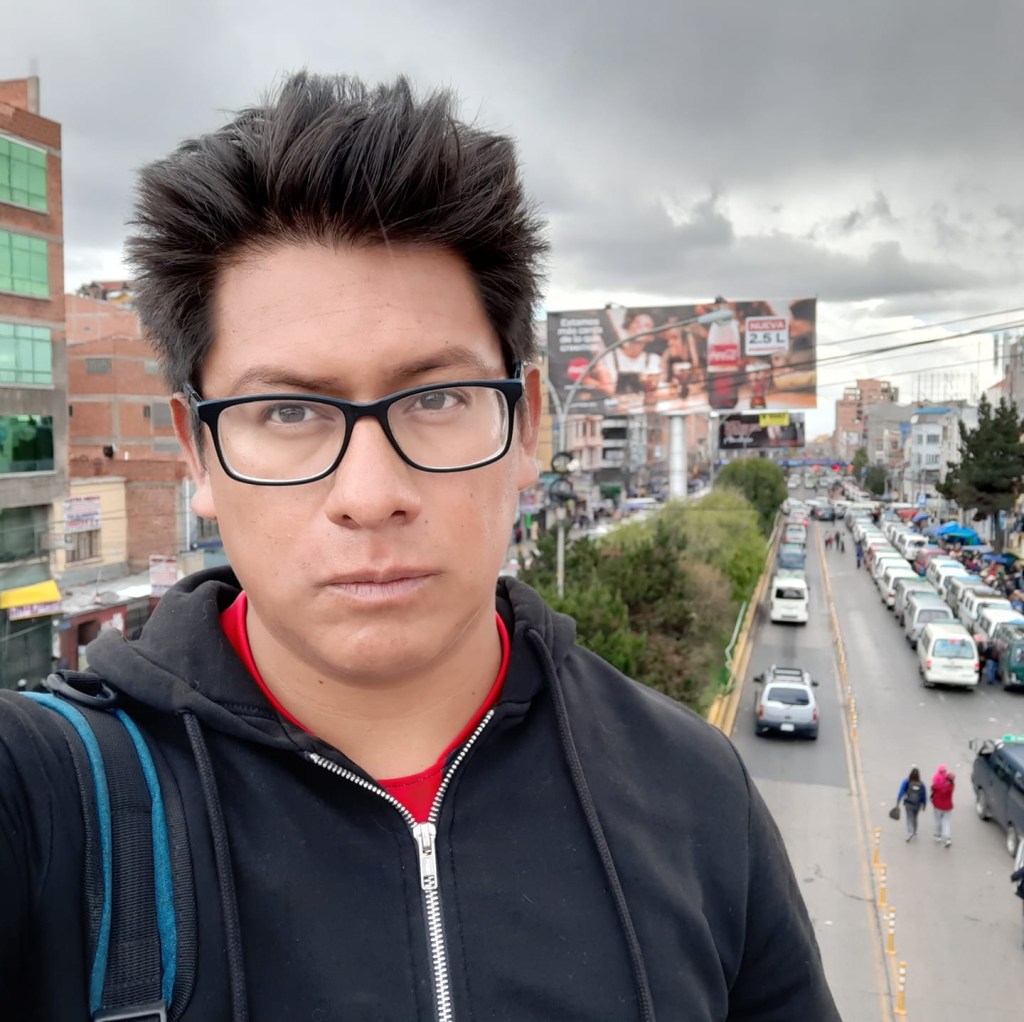
Rodrigo Urquiola Flores (Bolivia) is the author of the novels Lluvia de piedra (2011), El sonido de la muralla (2015), and Reconstrucción (2019), as well as several short story collections and plays. His work has earned numerous awards, including the Marcelo Quiroga Santa Cruz Prize, the Carlos Montemayor Inter-American Prize, the Santa Cruz de la Sierra Prize, and the Adolfo Costa du Rels Prize. His stories appear in multiple national and international anthologies.
 Literaven.com